Tree Traversal
17.4
Tree Traversal
- Visit all elements
- Different orderings are possible
- Inorder traversal
- preorder
- post order
Inorder Tree Traversal
- Inorder traversal
- Visit left subtree
- Visit root
- Visit right subtree
- In a Binary Search Tree, this gives the nodes in sorted order
Inorder Traversal Example - print
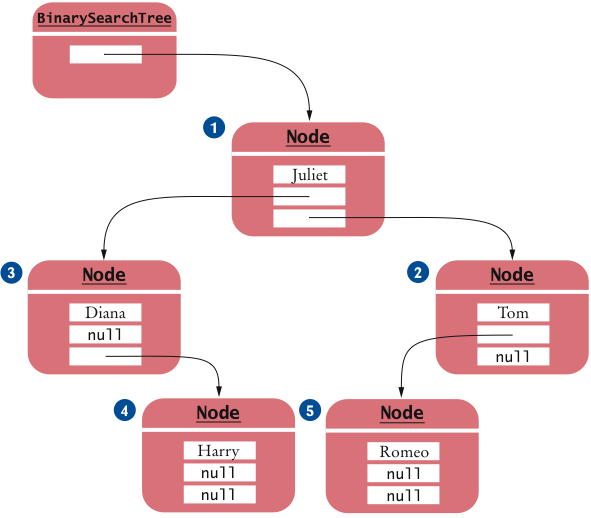
- Print the left subtree of Juliet (tree whose root is Diana)
- Print the root (Juliet)
- Print the right subtree of Juliet (Tom and all its descendants)
12/4 Class Question 1
What is the inorder traversal of the tree
   F
  / \
 D   R
  \
   E
- FDER
- EDFR
- DEFR
- Something else
Preorder/Postorder
- Preorder
- Visit root
- Visit the left child
- Visit the right child
- Postorder
- Visit the left child
- Visit the right child
- Visit root
- For general tree
- visit all the child nodes left to right
12/4 Class Question 1
What are preorder and postorder traversals of the tree
   F
  / \
 D   R
  \
   E
- FEDR, DEFR
- FDER, EDRF
- DEFR, ERDF
- something else
Postorder Traversal of Expression Tree

- Postorder traversals
3 4 + 5 *
3 4 5 * +
- Gives Reverse Polish Notation of expression
- Useful for in a stack-based calculator
Directory Operations
- Remove a directory and all its children

- Can only remove an empty directory
- Must operate on leaves first
- This is postorder
Directory Operations
- Copy a directory and all its children

- Must copy the parent before the children
- Start with the root so there is a place to put the children
- This is preorder
12/4 Class Question 2
Suppose you have two directory trees and you want to find out whether they
contain the same subdirectories, each of which contains the same files.
Should you traverse using
- inorder
- preorder
- postorder
- preorder or postorder
Visitor Pattern
- What do you want to do when you visit a node
- Print it?
- Delete or copy files?
- Create a generic interface
public interface Visitor
{
   void visit(Object data);
}
private static void preorder(Node n, Visitor v)
{
   if (n == null) { return; }
   v.visit(n.data);
   for (Node c : n.children) { preorder(c, v); }
}
public void preorder(Visitor v) { preorder(root, v); }
Example: Count Short Names
public static void main(String[] args)
{
   BinarySearchTree bst = . . .;
   class ShortNameCounter implements Visitor
   {
      public int counter = 0;
      public void visit(Object data)
      {
         if (data.toString().length() <= 5) { counter++; }
      }
   }
   ShortNameCounter v = new ShortNameCounter();
   bst.preorder(v);
   System.out.println("Short names: " + v.counter);
}
Depth-First Search

Breadth-First Search

12/4 Class Question 3
Suppose you have a binary tree of height n > 1. Can its
depth-first traversal ever be the same as its breadth-first traversal?
- No, never
- Yes, if it's not a binary search tree
- Yes, if it has n elements
- Yes, if the height is 2
Tree Iterators
class BreadthFirstIterator
{
   private Queue<Node> q;
   public BreadthFirstIterator(Node root)
   {
      q = new LinkedList<Node>();
      if (root != null) { q.add(root); }
   }
   public boolean hasNext() { return q.size() > 0; }
   public Object next()
   {
      Node n = q.remove();
      for (Node c : n.children) { q.add(c); }
      return n.data;
   }
}