Binary Search Trees
17.3
Binary Search Trees
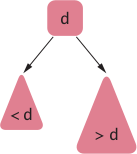
A binary search tree is a special case of a binary tree
- all the descendants ( the child node and all its children) to the left of each node have smaller data values than the node itself.
- And the descendants to the right have larger data values.
Binary Search Tree
We can only create a binary search tree of objects that are comparable in some fashion.
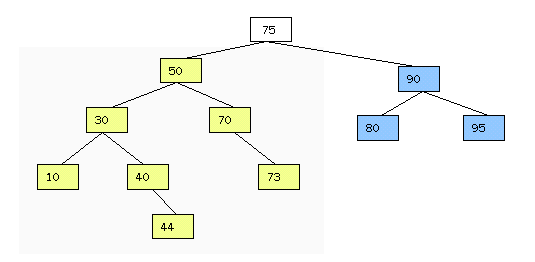
Here is a diagram of a binary search tree of integers.
Binary Search Tree
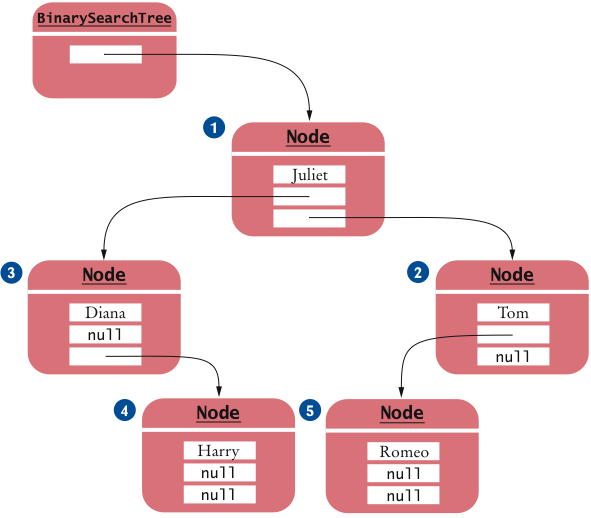
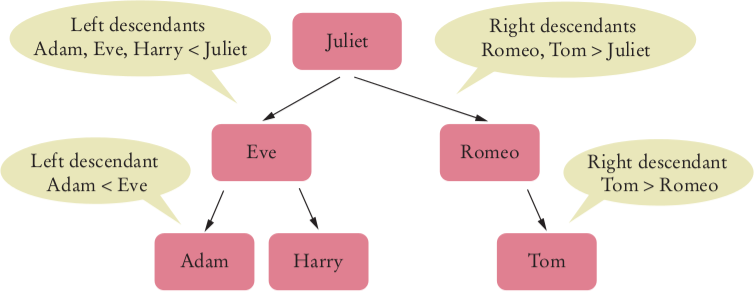
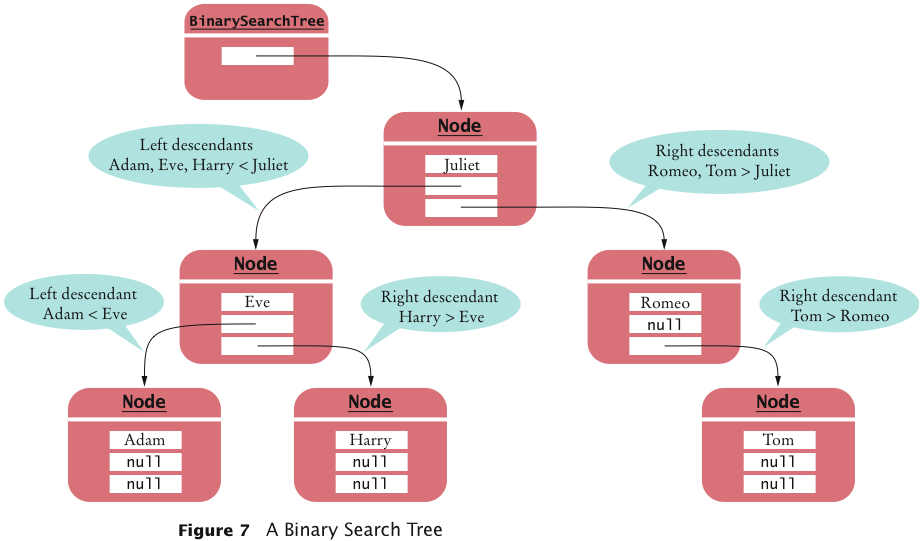
Here is a diagram of a binary search tree of Strings.
Binary Search Tree
This diagram has more detail
Not a Binary Search Tree
This is not a binary search tree
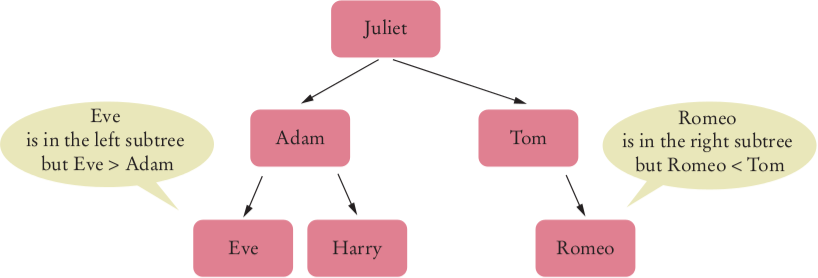
Romeo could be the left child
Implementing a Binary Search Tree
-
Implement a class for the tree containing a reference to the root node
-
Implement an inner class for the nodes
-
A node contains two references (to left and right child nodes)
-
A node contains a data field
-
The data field must be of type
Comparable, so that you can compare the values
in order to place them in the correct position in the binary search tree
Implementing a Binary Search Tree
public class BinarySearchTree
{
   private Node root;

   public BinarySearchTree() { . . . }
   public void add(Comparable obj) { . . . }
   . . .
   class Node
   {
      public Comparable data;
      public Node left;
      public Node right;

      public void addNode(Node newNode) { . . . }
      . . .
   }
}
Insertion
- Use a recursive algorithm
-
If you encounter a non-
null node reference, look at its data
value
-
If the
data value of that node is larger than the one you want to
insert,
continue the process with the left subtree
-
If the existing
data value is smaller,
continue the process with the right subtree
-
If you encounter a null node pointer, replace it with the new node
Class Question 1
Which tree is the result of inserting F R E D into an empty binary search
tree
   F
  / \
 D   R
  \
   E
   F
    \
     R
    /
   E
  /
 D
    F
   / \
  E   R
 /
D
- Something else
Implementing Insertion
add method in the BinarySearchTree Class
public void add(Comparable obj)
{
   Node newNode = new Node();
   newNode.data = obj;
   newNode.left = null;
   newNode.right = null;
   if (root == null) root = newNode;
   else root.addNode(newNode);
}
Implementing Insertion
addNode method of the Node class
class Node
{
   . . .
   public void addNode(Node newNode)
   {
      int comp = newNode.data.compareTo(data);
      if (comp < 0)
      {
         if (left == null) { left = newNode; }
         else { left.addNode(newNode); }
      }
      else if (comp > 0)
      {
         if (right == null) { right = newNode; }
         else { right.addNode(newNode); }
      }
   }
   . . .
}
Searching for an Element
- If the target equals the root element
- Else if target is less than root
- Otherwise, search the right subtree
Searching
- Similar to a binary search
- The amount left to search is cut in half each time
- O(log n) provided the tree is balanced
Class Question 2
Assume 1000 random integers were inserted into a BST. What is the maximum
comparisons needed to find whether the integer 42 is among them?
- 1000
- 512
- 10
- 1
Removal
- First find the element to remove
- If the element to be removed is leaf, just remove it
- If the element to be removed has only one child, that child replaces the node to be removed. (That's why you need ot remember the parent)
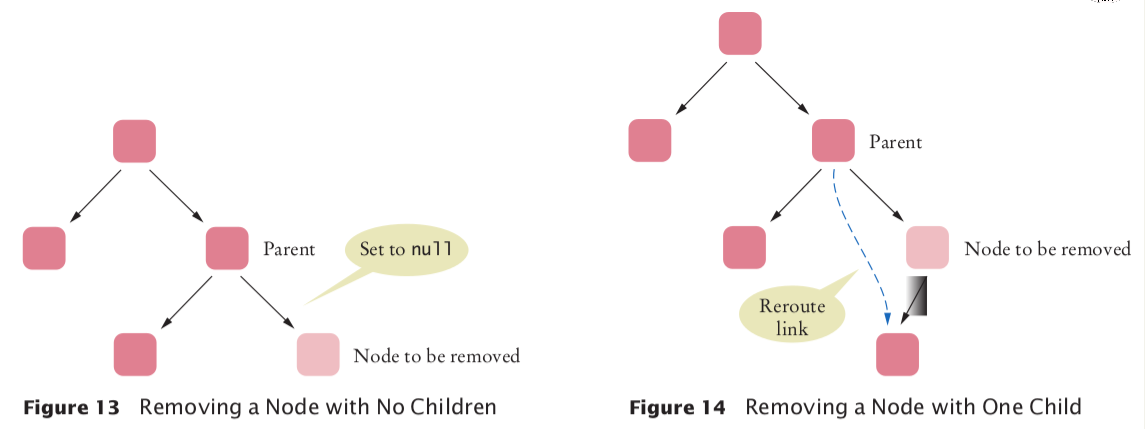
Removal
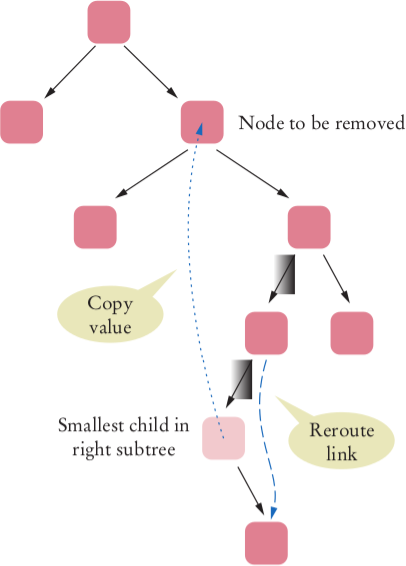
- Hard part: Removing node with two children
- Find smallest child in right subtree
- That node has at most one child
(a right child)
- Copy the value of that node to the node to be removed
- Remove that node (as in the previous slide)
Class Question 3
Consider this BST:
          C
         /  \
        A   G
           / \
          D   K
What is the result of removing C?
     G
    / \
   A   K
      /
     D
     A
      \
       G
      / \
     D   K
     D
    / \
   A   G
        \
         K
- Someting else
Efficiency
- Assumption: Balanced tree
- Finding an element: O(log n)
- Adding an element
- First find the element: O(log n)
- The a few fixed steps
- So it is O(log n)
- Removing an element
- Finding node to be removed: O(log n)
- Finding smallest child in right subtree: O(log n)
- O(log n) (if tree is balanced)
Class Question 4
You need to keep a set of lots of objects of class X. You don't care about
traversal in sorted order, but you want maximum efficiency. What should you
choose, and why?
- A hash table because its add/remove/find operations are O(1)+
- A re-balancing BST because its add/remove/find operations are guaranteed
to be O(log n)
- A hash table because it is easier to come up with a hashCode method for X
than a compareTo method
- A re-balancing BST because it is easier to come up with a compareTo method
for X than a hashCode method