Stacks and Queues
15.5 - 15.6
Stacks and Queues
-
Stack: collection of items with
last in, first out
retrieval
-
Queue: collection of items with
first in, first out
retrieval
Abstract Data Type (ADT)
- First let's define data type
- a set of values and the associated operations on those values
- in Java, the most basic data types are primitive data types
Integers as data types
- What numbers are in the set of integers?
- all the whole numbers, positive, negative, and zero
- What operations can be performed on these values?
- Addition, subtraction, multiplication, division, modulus
- Integers have
- a set of values
- associated operations.
- It is a data type.
- In Java, we call them ints
Boolean as a data type
- What is the set of values?
- What are the operations?
- AND (&&), OR (||) and NOT (!).
- Boolean has
- a set of values
- associated operations.
- It is a data type.
Java objects as data types
- We put primitive data types together in aggregates
- The operations on the data are defined in methods
- An objects has
- a set of values (instance variables)
- associated data (methods)
- It become new data types
Abstract Data Type
- has a set of values (objects)
- the basic operations that can be performed on that collection of data.
- It defines a new data type
- The concept is similar to a class
Abstract Data type
- defines the fundatmental operations on the data
- does not define the implementation
- There can be different implementations
Abstract Data Type
- There are two important parts to an ADT:
- its specification ( the data and operations) and
- its implementation (how the data is stored and the algorithms to accomplish the operations).
- there can be more than one implementation
- The user of the ADT does not need to know anything about the implementation.
- I need to know that ArrayList has add and get methods.
- I do not know or care how the data is actually stored or how the methods are implemented.
- In Java, abstract data types are implemented as classes
Array ADT
Array ADT
An array Abstract Data Type is a ordered sequence of elements. It provides random access
to a specific element in O(1) time by specifying an integer index. |
- In Java, an array is one implementation of the array ADT
- ArrayList is another implementation
List ADT
List ADT
A list Abstract Data Type is a ordered sequence of elements that can be traversed sequentually and allows for insertion and removal of elements at any position in O(1) time. |
- LinkedList is one implementation
Stack
- Allows insertion and removal of elements only at one end
-
Traditionally called the top of the stack
- New items are added to the top of the stack
-
Items are removed at the top of the stack
-
Called last in, first out or LIFO order
-
Traditionally, addition and removal operations are called
push and pop
-
Think of a stack of books:

Stack ADT
Stack ADT
A stack Abstract Data Type is a collection of elements that allows access only at one end, called the top. It is structured such that the last element added will be the first element removed. |
- This type of retrieval is called "last in, first out" or LIFO order.
- Implementation
- implemented using a LinkedList
- implemented using an array
Stack Operations
- push
- pop
- empty
- And also peek
Stacks in the Java Library
-
Class
Stack implements the abstract data type, stack
- has the
push and pop operations
- also peek to look at the top of the stack without removing it
- There is no Stack interface
Working with Stacks
Stack<Integer> s = new Stack<>(); |
Constructs an empty stack. |
s.push(1);

              s.push(2);

s.push(3); |
Adds to the top of the stack; s is now [1, 2,
3]. (Following the toString method of the Stack
class, we show the top of the stack at the end.) |
int top = s.pop(); |
Removes the top of the stack; top is set to 3 and s
is now [1, 2]. |
head = s.peek(); |
Gets the top of the stack without removing it; head
is set to 2. |
boolean b = s.empty() |
Sets b to false. Same as s.size() == 0. |
Queue
-
Add items to one end of the queue (the tail)
-
Remove items from the other end of the queue (the head)
-
Queues store items in a first in, first out or FIFO fashion
-
Items are removed in the same order in which they have been added
-
Think of people lining up:
-
People join the tail of the queue and wait until they have reached the head of
the queue
A Queue
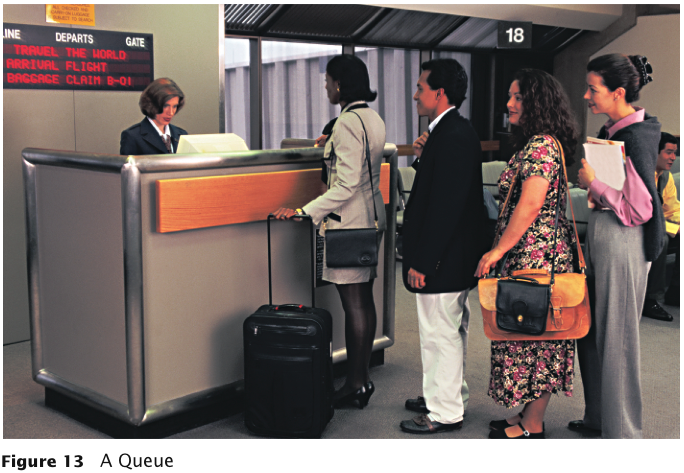
Queue ADT
Queue ADT
A queue Abstract Data Type is a collection of ordered elements structured such that the first element added will be the first element removed.
|
- This type of retrieval is called "first in, first out" or FIFO order.
- Items are added at one end of the queue (the tail) and removed from the other end (the head).
- Items in a queue "wait their turn."
- Implementation
- implemented using an array
- implemented using a linked list
Queue Operations
- add (enque)
- remove (deque)
- empty
- can also peek
Queues in the Java Library
Working with Queues
Queue<Integer> q = new LinkedList<>(); |
The LinkedList class implements the Queue interface. |
q.add(1); q.add(2); q.add(3); |
Adds to the tail of the queue; q is now [1,
2, 3] |
int head = q.remove(); |
Removes the head of the queue; head is set to 1 and
q is [2, 3] |
head = q.peek(); |
Gets the head of the queue without removing it; head
is set to 2. |
boolean b = s.empty() |
Sets b to false. Same as s.size() == 0. |
Priority Queues
- A collection of items, each with a priority
- Add elements in any order
- Remove the most urgent one
- Not a queue!

Priority Queue
- give low values to urgent priorities
- priority 1
denotes the most urgent priority.
- Thus, each removal operation extracts the
minimum element from the queue.
Priority Queue Example
Look at this code
- assume we have a WorkOrder class
- has a priority
- has a description
PriorityQueue<WorkOrder> q = new PriorityQueue<WorkOrder>();
q.add(new WorkOrder(3, "Shampoo carpets"));
q.add(new WorkOrder(1, "Fix broken sink"));
q.add(new WorkOrder(2, "Order cleaning supplies"));
Priority Queue Example cont.
Call q.remove() for the first time
- the work order with priority 1 is removed.
- if there are two elements with the same priority
-
the priority queue will choose arbitrarily
- priority queue needs to be able to tell which element is the smallest
- elements in the should belong to a class that implements the Comparable interface
Working with Priority Queues
PriorityQueue<Integer> q = new
PriorityQueue<>(); |
This priority queue holds Integer objects. In practice, you would
use objects that describe tasks. |
q.add(3); q.add(1); q.add(2); |
Adds values to the priority queue. |
int first = q.remove();

int second = q.remove(); |
Each call to remove removes the most urgent item: first
is set to 1, second to 2. |
int next = q.peek(); |
|
|
|
|
|
Thoughts to ponder
- Why would you want to declare a variable as
Queue<String> q = new LinkedList<String>()
instead of simply declaring it as a linked list?
- Would it be a good idea to use a stack to manage print jobs?
Class Question 1
What does this code print?
Stack<Integer> s = new Stack<>();
Queue<Integer> q = new LinkedList<>();
PriorityQueue<Integer> p = new PriorityQueue<>();
s.push(1); s.push(3); s.push(2);
while (s.size() > 0) q.add(s.pop());
while (q.size() > 0) p.add(q.remove());
while (p.size() > 0) System.out.print(p.remove() + " ");
- 1 3 2
- 1 2 3
- 3 2 1
- 2 3 1
Stacks and Queues: Uses in Computer Science
-
Queue
-
Event queue of all events, kept by the Java GUI system
-
Queue of print jobs
-
Stack
-
Run-time stack that a processor or virtual machine keeps to organize the
variables of nested methods
- expression evaluation in compilers
Application: Balancing Parentheses
- Easy to check whether parentheses are balanced
- Example: -(b * b - (4 * a * c ) ) / (2 * a)
- Increment counter at (, decrement at )
- Counter must be 0 at end and never < 0 in the middle
- What if we have different kinds of parentheses?
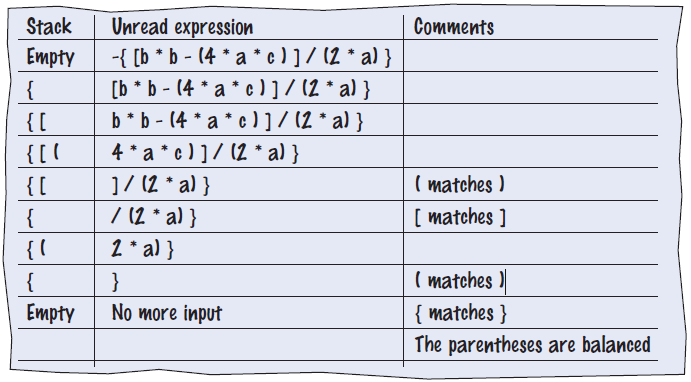
- –{ [b ⋅ b - (4 ⋅ a ⋅ c ) ] / (2 ⋅ a) }
- Push them on a stack
Application: Balancing Parentheses
When you see an opening parenthesis, push it on the stack.
When you see a closing parenthesis, pop the stack.
If the opening and closing parentheses don’t match
   The parentheses are unbalanced. Exit.
If at the end the stack is empty
   The parentheses are balanced.
Else
   The parentheses are not balanced.
Application: Balancing Parentheses
Evaluating Reverse Polish Expressions
- Infix operators need parentheses to specify what comes first: (3 + 4)
* 5
- Polish notation: Write operator before operands
- * + 3 4 5
- Invented by the Polish mathematician Jan Łukasiewicz
- Reverse Polish: Write them after the operand
- 3 4 + 5 *
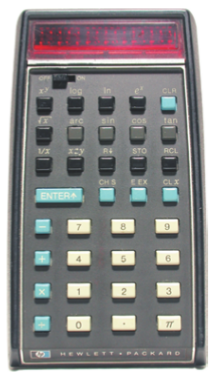
- Used in classic pocket calculators and the Java virtual machine
Reverse Polish Notation
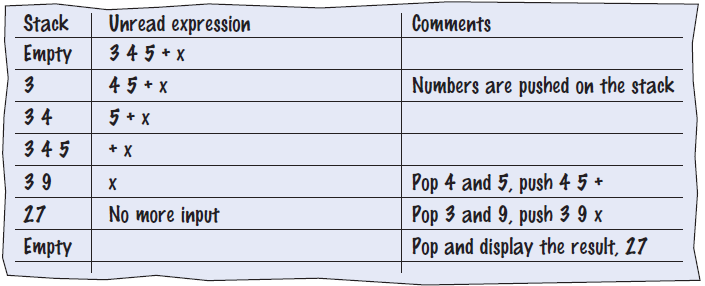
If you read a number
   Push it on the stack.
Else if you read an operand
   Pop two values off the stack.
   Combine the values with the operand.
   Push the result back onto the stack.
Else if there is no more input
   Pop and display the result.
Reverse Polish Notation
Lecture 15 Clicker Question 2
How do you write (3 + 4) x 5 + 6 in Reverse Polish?
- 3 4 5 x + 6 +
- 3 4 + 5 x 6 +
- 3 + 4 5 x + 6
- None of the above
Evaluating Algebraic Expressions
- Regular notation, not reverse polish
- Push numbers on one stack, operators on another
- Core step—evaluating the top:
- Pop two numbers
- Pop an operator
- Apply operator to numbers
- Push the result
Number stack
|
Operator stack
|
Unprocessed input
|
Comments
|
|
|
3 + 4
|
|
3
|
|
+ 4
|
|
3
|
+
|
4
|
|
4
3
|
+
|
No more input
|
Evaluate the top
|
7
|
|
|
The result is 7
|
Operator Precedence
- * has higher precedence than +
- * and / have the same precedence
- Don't push an operator if it has higher precedence than the top
operator. Instead, evaluate the top.
Number stack
|
Operator stack
|
Unprocessed input
|
Comments
|
|
|
3 * 4 + 5
|
|
3
|
|
* 4 + 5
|
|
3
|
*
|
4 + 5
|
|
4
3
|
*
|
+ 5
|
* has higher precedence
Evaluate the top
|
12
|
+
|
5
|
Now push +
|
5
12
|
+
|
No more input
|
Evaluate the top
|
17
|
|
|
The result is 17
|
Parentheses
- Push a left parenthesis "("
- When encountering a right parentesis ")", evaluate the top until the left paren "(" reappears
Number stack
|
Operator stack
|
Unprocessed input
|
Comments
|
|
|
3 * (4 + 5)
|
|
3
|
|
* (4 + 5)
|
|
3
|
*
|
(4 + 5)
|
|
|
(
*
|
4 + 5)
|
|
4
3
|
(
*
|
+ 5)
|
|
4
3
|
+
(
*
|
5)
|
|
5
4
3
|
+
(
*
|
)
|
|
9
3
|
(
*
|
No more input
|
Evaluate the top
|
9
3
|
*
|
|
Pop matching (
|
27
|
|
|
Evaluate the top—the result is 27
|
Complete Algorithm
If you read a number
Push it on the number stack.
Else if you read a (
Push it on the operator stack.
Else if you read an operator op
While the top of the stack has a higher precedence than op
Evaluate the top.
Push op on the operator stack.
Else if you read a )
While the top of the stack is not a (
Evaluate the top.
Pop the (.
Else if there is no more input
While the operator stack is not empty
Evaluate the top.
Backtracking
- Escaping from a maze
- Use a stack to remember all paths that still need to be tried
- At an intersection, push all paths
- Pop one and follow it
- When a path is a dead end, pop the next one (that's the backtracking)
- Repeat until exit
- Can use a queue as well, but not as intuitive (you don't just go back
to the last choice)
Maze Escape Example
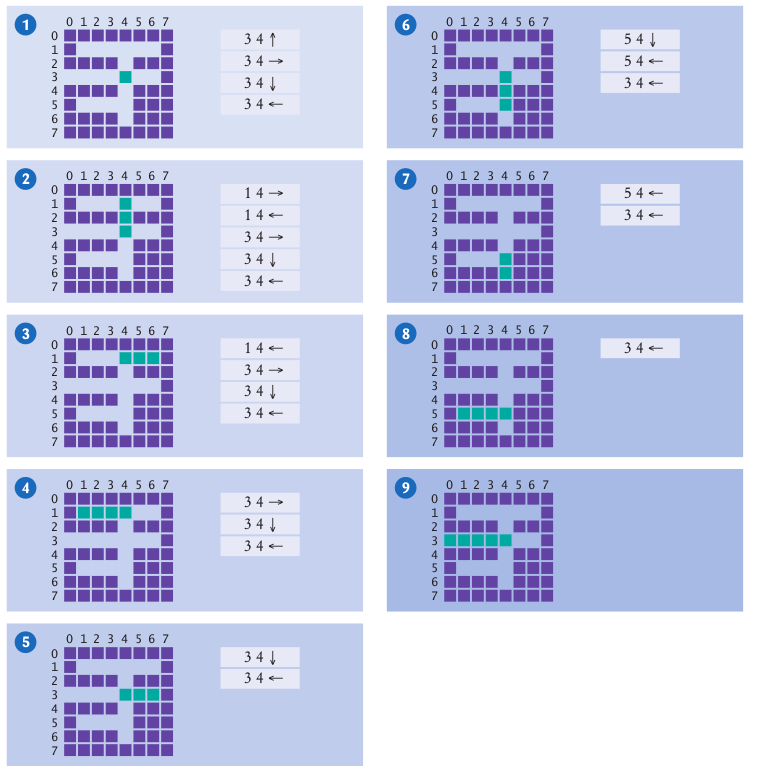
Maze Escape Pseudocode
Push all paths from the point on which you are standing on a stack.
While the stack is not empty
	 Pop a path from the stack.
	 Follow the path until you reach an exit, intersection, or dead end.
	 If you found an exit
		 Congratulations!
	 Else if you found an intersection
		 Push all paths meeting at the intersection, except the current one, onto the stack.